
The United Kingdom’s Austerity Measures (2010s): Economic and Social Impact
Introduction
In the aftermath of the 2008 global financial crisis, the United Kingdom pursued an ambitious austerity agenda aimed at reducing public spending and restoring fiscal discipline. Introduced by the Conservative-led coalition government in 2010, the programme of austerity continued throughout the 2010s, significantly altering the UK’s economic governance and public service landscape. While proponents claimed it was essential for economic recovery and deficit reduction, critics argued that austerity entrenched social inequalities, undermined welfare provisions, and impeded economic growth. This article analyses the origins, implementation, and consequences of the UK’s austerity measures, examining their lasting impact on the national economy and society.
Origins and Objectives
The austerity policy was introduced in response to a sharp rise in government debt following the banking collapse and recession of 2008–2009. The UK’s budget deficit reached over 10% of GDP, prompting concerns about sovereign debt levels and market confidence.
The key objectives of the austerity programme were to:
- Reduce the fiscal deficit through substantial cuts in public expenditure
- Shrink the welfare state, promoting individual responsibility over state dependence
- Stimulate private sector-led growth, assuming that reduced state intervention would encourage entrepreneurship and investment
These goals were outlined in successive budgets under Chancellor George Osborne, forming the economic basis of the Coalition (2010–2015) and Conservative (2015–2019) governments.
Implementation and Key Policies
Austerity was implemented across multiple sectors through a combination of expenditure cuts, benefit reforms, and public sector restructuring.
1. Welfare Reforms
Major reductions were made to housing benefits, disability allowances, and child tax credits. The introduction of Universal Credit consolidated six welfare payments but faced criticism over delays and hardship during rollout.
2. Health and Social Care Funding
Although NHS spending was nominally protected, real-term growth was minimal, failing to keep pace with rising demand. Local authority funding for social care was sharply curtailed, leading to a crisis in services for the elderly and disabled.
3. Education and Local Government Cuts
School budgets faced pressures despite increases in pupil numbers, and local councils experienced funding reductions averaging over 40% in real terms, severely affecting libraries, youth services, and social housing.
4. Public Sector Employment
Austerity led to widespread public sector job losses, pay freezes, and pension reforms. Between 2010 and 2017, approximately 1 million public sector jobs were lost or outsourced.
Economic Consequences
1. Fiscal Consolidation with Slower Growth
The UK’s budget deficit was reduced from 10% to under 2% of GDP by 2018, but at the expense of sluggish economic growth. GDP growth remained below pre-crisis levels, with weak productivity gains.
2. Rising Inequality and Poverty
Austerity disproportionately impacted low-income households, exacerbating income inequality. The Institute for Fiscal Studies (IFS) reported that the poorest decile saw larger proportional income losses than the wealthiest.
3. Public Service Deterioration
Reductions in funding compromised the quality and accessibility of essential public services, particularly in healthcare, social care, education, and housing. NHS waiting times rose, and homelessness increased substantially.
4. Regional Disparities
Cuts disproportionately affected post-industrial and northern regions, widening the economic divide between London and the South East and other parts of the UK.
Political and Public Response
1. Public Protests and Labour Opposition
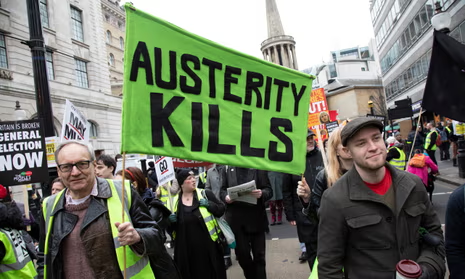
Austerity measures were met with widespread opposition. Protests organised by groups such as the People’s Assembly Against Austerity highlighted the social costs. The Labour Party, particularly under Jeremy Corbyn’s leadership, positioned itself firmly against austerity, advocating for increased public investment.
2. Criticism from Economists
Prominent economists, including Joseph Stiglitz and Paul Krugman, criticised austerity as counterproductive during a low-growth recovery period. Some IMF and OECD reports also expressed concern about demand suppression caused by premature fiscal tightening.
3. Shifting Policy Rhetoric
By the late 2010s, political rhetoric shifted. The 2019 Conservative manifesto notably moved away from strict austerity, promising increased spending on healthcare, infrastructure, and policing, signalling a broader ideological pivot.
Conclusion
The United Kingdom’s austerity programme of the 2010s brought about a fundamental reorientation of economic governance, with lasting consequences for public services, income distribution, and political discourse. While the policy achieved a measure of fiscal consolidation, it came at the cost of social hardship, rising inequality, and weakened service provision. The long-term effectiveness of austerity remains contested, with many questioning whether the economic costs outweighed the fiscal benefits. As debates continue over post-pandemic recovery strategies, the legacy of UK austerity policies remains highly relevant to future public spending, welfare, and governance frameworks.